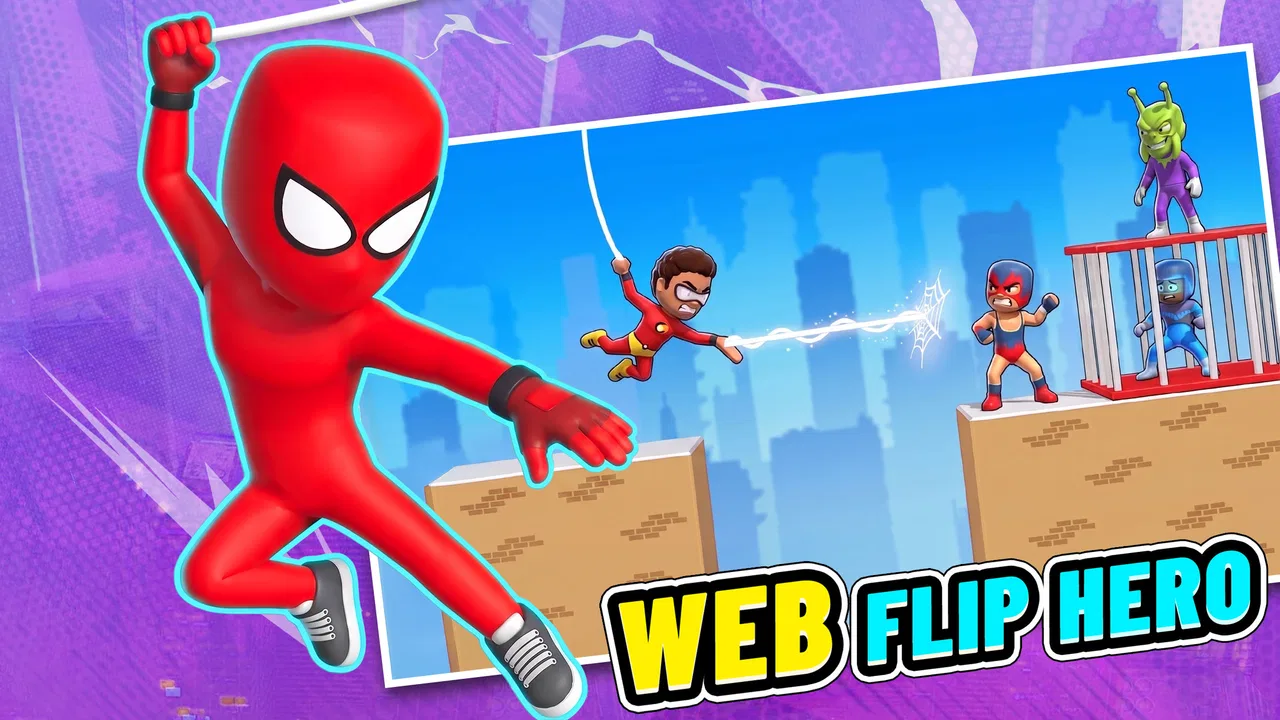
Web Flip Hero: Swing & Hit
- 3.8
- Rating
- 100.00K
- Installs
- Free
- Price

 Analysis by App-foxy
I spent time with Web Flip Hero: Swing & Hit as a quick arcade game built around one deceptively simple question: can I line up a flip, guide the character, and finish the shot cleanly? The idea is easy to understand within moments, but the timing makes it more demanding than the short store summary suggests. It is the kind of game I can open for a brief break, yet it also invites repeated attempts when a near-perfect move feels just out of reach.
Developed by FusionArc Games, this free arcade title is aimed at everyone rather than a specific age group. It has an average rating of 3.8 from 126 ratings and has passed 100K+ installs, which gives it a modest but established player base. The release date is May 5, 2026, and the current version is 1.3. On Android, it requires at least OS 7.1, so it should remain accessible on a wide range of older devices.
How the basic swing-and-hit routine feels in practice
The first thing I noticed is that the game does not need a long explanation to become playable. The central routine is built around flipping and guiding the hero toward a successful hit. That makes the opening minutes approachable: I can experiment, miss, and immediately understand why the attempt failed without reading a complicated tutorial.
You May Also Like

 Blood Strike: 2.5 Anniversary
Blood Strike’s Loadouts Turn Every Drop Into a Tactical Gamble
A close look at Blood Strike’s custom loadouts: how fast access to signature weapons reshapes its battle royale rhythm, rewards preparation, and narrows the gap between fights.

 Pandora - Music & Podcasts
Pandora’s Music Is Easy to Start, but Harder to Recover
Pandora’s strength is its low-effort path from a seed to a station. Its weak spot is how much confidence it asks you to place in connection, setup, and quiet recovery.

 8 Ball Pool
 Is Built on Rivalries, Rematches, and Routine
A close look at the rivalries, rematches, shared routines, and unanswered safety questions that turn a quick pool match into a persistent mobile community.

 Samsung Music
’s Quiet Strength Is Playing What You Already Own
Its reach comes less from spectacle than from dependable access to a personal library. That simplicity is both the app’s strongest retention engine and its ceiling.

 AccuWeather: Weather Radar
AccuWeather Review: A Quick, Clear Forecast for Everyday Decisions
For everyday plans, the best forecast is the one you can understand quickly. AccuWeather makes rain timing, radar, and local conditions easy to act on, with a few trade-offs.

 Hill Climb Racing
Why Hill Climb Racing Still Turns Crashes Into One More Run
A tiny car, a bumpy hill and one more upgrade: Hill Climb Racing keeps resurfacing because its simple chaos makes every near-miss feel personal.
More From Our News Desk
View All News


That simplicity is also where the challenge begins. A successful move depends less on frantic input and more on reading the character’s position before committing. When I rushed, I tended to correct too late. When I watched the movement and treated each attempt as a small timing exercise, the results became more consistent. The game rewards a calm rhythm more than constant tapping.
My usual baseline workflow was straightforward. I would begin with a few attempts focused only on understanding the current movement, then pay attention to the point at which the hero appeared easiest to guide. Rather than trying to force a spectacular result immediately, I used the first attempts to identify the safe timing window. That habit made the game feel less random and more like a compact skill test.
For a short everyday session, this works well. I could imagine playing it while waiting for a bus, taking a break between tasks, or winding down without wanting a large adventure game. Each attempt has a clear purpose, and the controls do not demand a large time commitment. If I had only a few minutes, I could still finish a meaningful session instead of stopping halfway through a long level.
The important distinction is that this is not really a game for players who want a deep story, character collection, or extensive exploration. Its appeal comes from repeating a focused action and gradually improving the execution. Someone looking for a large arcade package with many separate modes may find the experience narrow. Someone who enjoys polishing one movement until it feels reliable will probably understand the appeal quickly.
What I learned from treating each attempt as practice
My most useful early adjustment was to stop judging an attempt only by whether it succeeded. A failed flip can still show whether I started too early, overcorrected, or ignored the hero’s position. This changed the pace of play. Instead of immediately repeating the same input, I tried to name the mistake before attempting again.
That approach is especially helpful on a touch screen, where a small difference in timing can change the result. I found it better to use deliberate gestures than nervous, repeated touches. The game’s premise encourages quick reactions, but my best results came from making fewer decisions and making each one with more attention.
There is also a practical benefit to keeping sessions short. Playing for too long while frustrated made my timing worse. After several rushed attempts, I would start reacting to the previous failure rather than the current position. A brief pause helped more than forcing another run. This is a small habit, but it suits the game’s compact arcade structure.
The strongest part of the design is the clear connection between timing and outcome. I rarely felt that success depended on learning a complicated system. Instead, the game asks me to improve a single kind of coordination. That clarity makes every small improvement noticeable, even when the overall feature set remains limited.
Settings and device habits worth checking before serious play
There is no reason to assume that every phone will feel identical. Touch response, screen size, and the way I hold the device can all affect a timing-based game. Before trying to improve a personal best, I recommend checking the available in-game settings and the phone’s own sound and display controls. I would not change everything at once; making one adjustment at a time makes it easier to tell what actually helps.
I found that holding the phone in a stable position mattered more than I expected. When I played while walking or balancing the device in one hand, my input became less consistent. A two-handed grip or a supported phone gave me a clearer view and reduced accidental movement. This is not a hidden trick, but it is a realistic difference between a casual attempt and a focused run.
Sound is another setting worth considering. If the game provides audio controls, I would test both with sound and without it rather than assuming one is automatically better. A sound cue can help some players build a rhythm, while others may find it distracting. For me, visual timing remained more dependable, but audio could still make a short session feel more responsive.
Brightness and screen cleanliness also deserve attention. Because the action depends on following the hero’s position, glare or fingerprints can make a small character harder to read. I got more reliable results when the screen was bright enough for comfortable viewing but not so bright that it became tiring. This matters particularly during outdoor play, where reflections can turn a precise gesture into guesswork.
The minimum operating-system requirement is Android 7.1, which is useful to know before downloading. It suggests that the game is not restricted to recent phones, although the experience can still vary with hardware and touch sensitivity. I would make sure the device is not struggling with background tasks before blaming my timing. A smooth screen response is more important here than having a powerful gaming phone.
One setting-related habit I recommend is keeping the play environment consistent when practicing. If I change grip, brightness, sound, and posture between every attempt, I cannot tell whether I am improving or simply adapting to a different setup. Experienced players often create a repeatable routine without needing special tools: same orientation, similar grip, and a short warm-up before attempting difficult shots.
Small shortcuts that improve consistency without changing the game
The most useful shortcut is mental rather than technical: focus on the next contact point instead of the final result. When I stared at the goal, I tended to rush the flip. When I watched the hero’s immediate path, my timing became more controlled. This keeps the decision small and prevents the whole attempt from feeling like one oversized reaction.
I also found it helpful to use a reset rule. If an attempt began badly, I stopped trying to rescue it with a chain of hurried corrections. I let it end, noted the mistake, and started fresh. That may sound less exciting than improvising, but it prevents one poor decision from turning into several more. In a game built around repeatable movement, clean resets are more valuable than desperate recoveries.
Another practical shortcut is to play in batches. I would make a few attempts with one specific goal, such as starting later or using a gentler correction, rather than changing the plan every time. This creates a simple comparison between attempts. It also makes progress easier to notice because I am testing one habit rather than relying on vague impressions.
Faster patterns for players who want more control
Once the basic movement became familiar, I started looking for patterns instead of isolated successes. The key pattern was to separate observation from action. I watched the hero’s position, anticipated the next moment, and then committed. That sequence felt slower at first, but it produced faster improvement than reacting after the movement had already begun.
I would describe the best repeatable pattern as observe, commit, and review. During the first phase, I watched the current motion without trying to correct everything. During the second, I made the main input with a clear intention. During the third, I considered whether the result came from timing, direction, or an unnecessary correction. This routine is simple enough for casual players but structured enough to help someone who wants mastery.
It is tempting to copy the gesture that worked once. I found that less useful than copying the conditions around it. Was the phone steady? Was I watching the character or the target? Did I make one confident input or several small ones? Recreating those conditions made success more repeatable than trying to imitate a single lucky movement.
For everyday play, I would use different goals depending on my available time. In a two-minute session, I would focus on clean execution and stop after identifying one useful adjustment. With more time, I would run a small practice set and compare the results. This keeps the game from becoming an endless loop of emotionally charged retries.
The game is also a good fit for players who enjoy “one more try” design, but that structure has a trade-off. Repetition is satisfying only while I can feel a connection between effort and improvement. If a player needs frequent new environments, changing rules, or a strong sense of progression, the repeated flip-and-hit routine may lose its appeal sooner than a broader arcade game would.
Where the usual arcade alternatives may be better
Compared with an endless runner, this game feels more focused and less dependent on covering distance. I am not managing a long chain of obstacles or collecting a wide range of items; I am concentrating on the quality of a specific movement. That makes it easier to practice one skill, but it also means there is less variety from moment to moment.
Compared with a physics puzzle, the experience is more immediate. I do not need to plan a large sequence of objects or understand a complicated environment before playing. The trade-off is that players who enjoy experimentation with elaborate systems may find the mechanics here too concentrated. Web Flip Hero: Swing & Hit is closer to a timing drill wrapped in an arcade format than to a full physics sandbox.
Compared with a reflex game built around constant speed, it gives me more reason to pause and read the situation. That can be a strength for players who prefer controlled timing over frantic reactions. On the other hand, people who want nonstop action may consider the deliberate rhythm less exciting. The better choice depends on whether the satisfaction comes from speed, variety, or refining one repeatable action.
The free price makes it easy to try without committing money, and the Everyone rating broadens its audience. Still, free access does not automatically make it the right fit. I would skip it if I wanted a substantial campaign, a strong narrative, or a large collection of modes. I would also look elsewhere if I know I dislike repeating a short interaction many times to improve by small increments.
Advanced limits and the point where practice stops paying off
After the initial learning curve, the game’s limitations become clearer. The central mechanic is approachable, but a focused mechanic can also feel repetitive once the novelty fades. The experience depends heavily on whether the player enjoys incremental improvement. If the movement stops teaching new lessons, later attempts may feel like repetition rather than discovery.
Another limit is the absence of a broader context around the action. A player may become better at the flip and hit, yet still want more reasons to return. Without inventing systems that are not confirmed, I would judge the game primarily as a compact arcade challenge rather than a long-term progression game. That expectation matters: it is easier to appreciate the design when I do not demand the depth of a larger title.
There is also a ceiling to how much settings can solve. A stable grip and comfortable display can remove avoidable friction, but they cannot replace timing practice. If a player keeps changing the phone setup in search of an easier result, the process can become a distraction. Once the controls feel responsive, improvement comes from reading movement and making cleaner decisions.
For advanced practice, I recommend recording mental notes rather than relying on vague frustration. After a miss, I would classify it as an early commitment, a late correction, or an unstable input. Then I would change only one factor on the next attempt. This is a more reliable workflow than trying to play faster after every failure.
I would also set a stopping point. If three or four attempts produce the same mistake, taking a break is more productive than repeating it without reflection. The game is well suited to short, focused practice, but it does not reward exhausted attention. In my experience, the difference between useful repetition and empty repetition is whether I can explain what I am trying to improve.
Players wondering whether it works for children should find the Everyone content rating reassuring, while younger players may still benefit from a comfortable grip and supervision if touch controls are unfamiliar. For older phones, the Android 7.1 minimum is encouraging, but I would still test responsiveness before expecting precise results. For anyone asking whether it is suitable offline or whether it includes particular progression systems, I would make the decision based on the core arcade loop rather than assuming features that are not clearly part of the experience.
My mastery verdict after settling into the rhythm
I enjoyed Web Flip Hero: Swing & Hit most when I treated it as a small skill game rather than a complete entertainment package. The flip-and-hit idea is immediately understandable, and the timing gives it enough depth to support repeated practice. My best sessions came from steady posture, deliberate inputs, and a simple review after each miss.
FusionArc Games has kept the concept accessible, which suits the free format and Everyone rating. The game can work for a casual player who wants a short distraction, but it also offers a modest challenge for someone who likes improving coordination. Its rating of 3.8 reflects a mixed but respectable reception, and the install count above 100K shows that the concept has found an audience without needing to be treated as a massive mainstream release.
My recommendation is specific: try it if you enjoy timing-based arcade play, short sessions, and the satisfaction of turning an awkward movement into a reliable one. Approach it with a stable setup, give yourself a few attempts to read the motion, and avoid changing several habits at once. Those choices make the experience feel more skillful and less dependent on luck.
I would point a friend toward another arcade game if they wanted constant novelty, a long progression path, or a story-driven reason to keep playing. I would also warn impatient players that the simple controls do not mean every shot will be easy. The game’s challenge is concentrated in execution, and that can either be its best quality or its main weakness.
In the end, I see this as a focused, approachable arcade title with a clear identity. It does not try to replace a larger game, and it should not be judged by that standard. When I want a brief challenge built around timing, observation, and repeatable habits, it does the job well. For players who enjoy mastering one satisfying movement, it is worth a free try; for everyone else, its narrow loop may be the reason to move on.
FAQs for Web Flip Hero: Swing & Hit
01What is the main objective of Web Flip Hero: Swing & Hit?
Web Flip Hero: Swing & Hit is a thrilling action game where players assume the role of a superhero swinging through the city using webs. The main objective is to navigate through various challenging levels, avoiding obstacles and hitting targets to achieve high scores. The game combines elements of precision, timing, and strategy, offering a unique and engaging experience.
02Is Web Flip Hero: Swing & Hit suitable for all age groups?
Yes, Web Flip Hero: Swing & Hit is designed to be family-friendly and suitable for players of all ages. The game features simple controls and colorful graphics that appeal to younger audiences, while the increasing challenge levels keep older players engaged. However, parental guidance is recommended for younger children to ensure appropriate screen time.
03What are the key features of Web Flip Hero: Swing & Hit?
Web Flip Hero: Swing & Hit boasts several exciting features, including intuitive swing mechanics, a variety of levels with unique challenges, and vibrant graphics. Players can unlock different superhero characters and power-ups, enhancing gameplay. The game also offers a leaderboard system, allowing players to compete with friends and other players globally.
04Does Web Flip Hero: Swing & Hit require an internet connection to play?
No, Web Flip Hero: Swing & Hit does not require an internet connection to enjoy the core gameplay. Players can swing through levels and hit targets offline. However, an internet connection is needed for accessing leaderboards, updates, and certain in-app purchases, enhancing the overall experience.
05Are there in-app purchases in Web Flip Hero: Swing & Hit?
Yes, Web Flip Hero: Swing & Hit includes in-app purchases that allow players to enhance their gaming experience. Players can buy additional characters, power-ups, and cosmetic items. While these purchases can provide an advantage, they are not necessary to enjoy the full game, as all levels and core features are accessible without spending money.
Pros
- Intuitive controls for easy gameplay.
- Stunning graphics with vibrant colors.
- Engaging levels that increase in difficulty.
- Frequent updates with new content.
- Offline mode available for on-the-go play.
Cons
- In-app purchases can be pricey.
- Advertisements can interrupt gameplay.
- Limited character customization options.
- Occasional lag on older devices.
- Requires internet for certain features.

Web Flip Hero: Swing & Hit
Gallery